
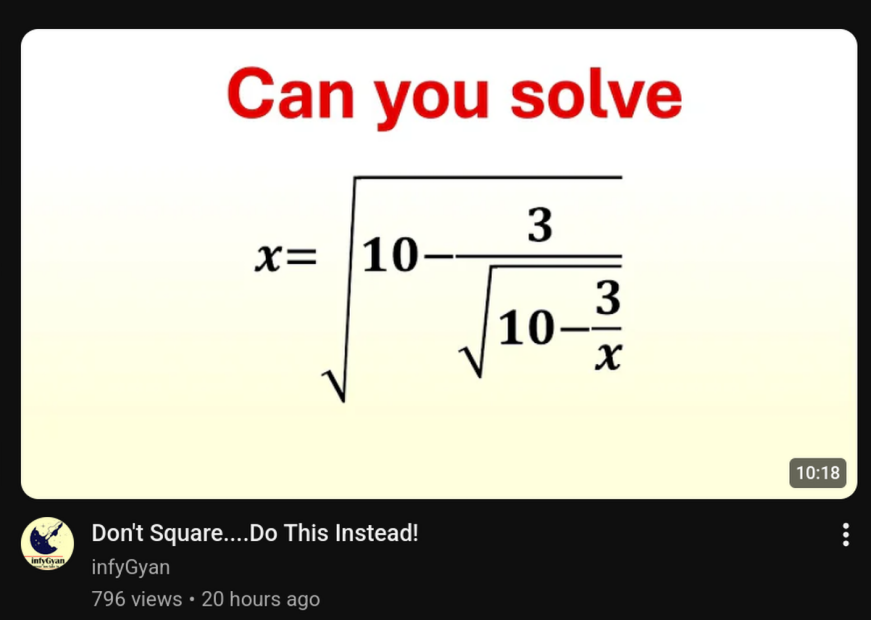
Don’t square? Why not? Okay, fine, we’ll do something else.
The big expression in the question has an obvious recursive structure. If we define , the question’s equation becomes .
Generally speaking, the solutions to an equation of the form are known as the fixed points of . Clearly, the fixed points of any will also be fixed points of This follows immediately from the definition of a fixed point. We can exploit this observation to simplify the problem of finding fixed points of to finding the fixed points of . So let’s find the fixed points of by simply writing the equation and solving it:
With a little massaging, this becomes the cubic
By inspection, is a factor. Dividing by this monomial, we’re left with . After using the quadratic formula, we end up with 3 roots:
These are solutions to the original question, except the negative root which turns out not to work when substituted, so we discard it.
One solution to this problem is probably already enough, but I feel compelled to admit that I glossed over something when I mentioned inheriting the fixed points of . It is possible, in general, that has additional fixed points that does not. This is pretty easy to see. Imagine some sends to and to . In that case, and are not fixed points of , but they will be fixed points of . That is, and implies and . The same kind of situation applies to higher-order iterations too.
There is also a graph-theoretic way to view this. Associate with a graph whose vertex set is the union of the domain and range of , and which has an edge wherever . In this setting, fixed points are loops, that is, edges from a vertex to the same vertex. If we construct in the same fashion, 2-cycles in will correspond with loops in . Specifically, every vertex involved in a 2-cycle in will have a loop on it in . In terms of adjacency matrices, notice that if ‘s is , ‘s is . Then the statement “ may have fixed points that does not” is the same as “ may have nonzero diagonal entries where does not”.
Do any such additional fixed points exist for this particular problem’s ? This addendum has already dragged on, so I leave it as an exercise.